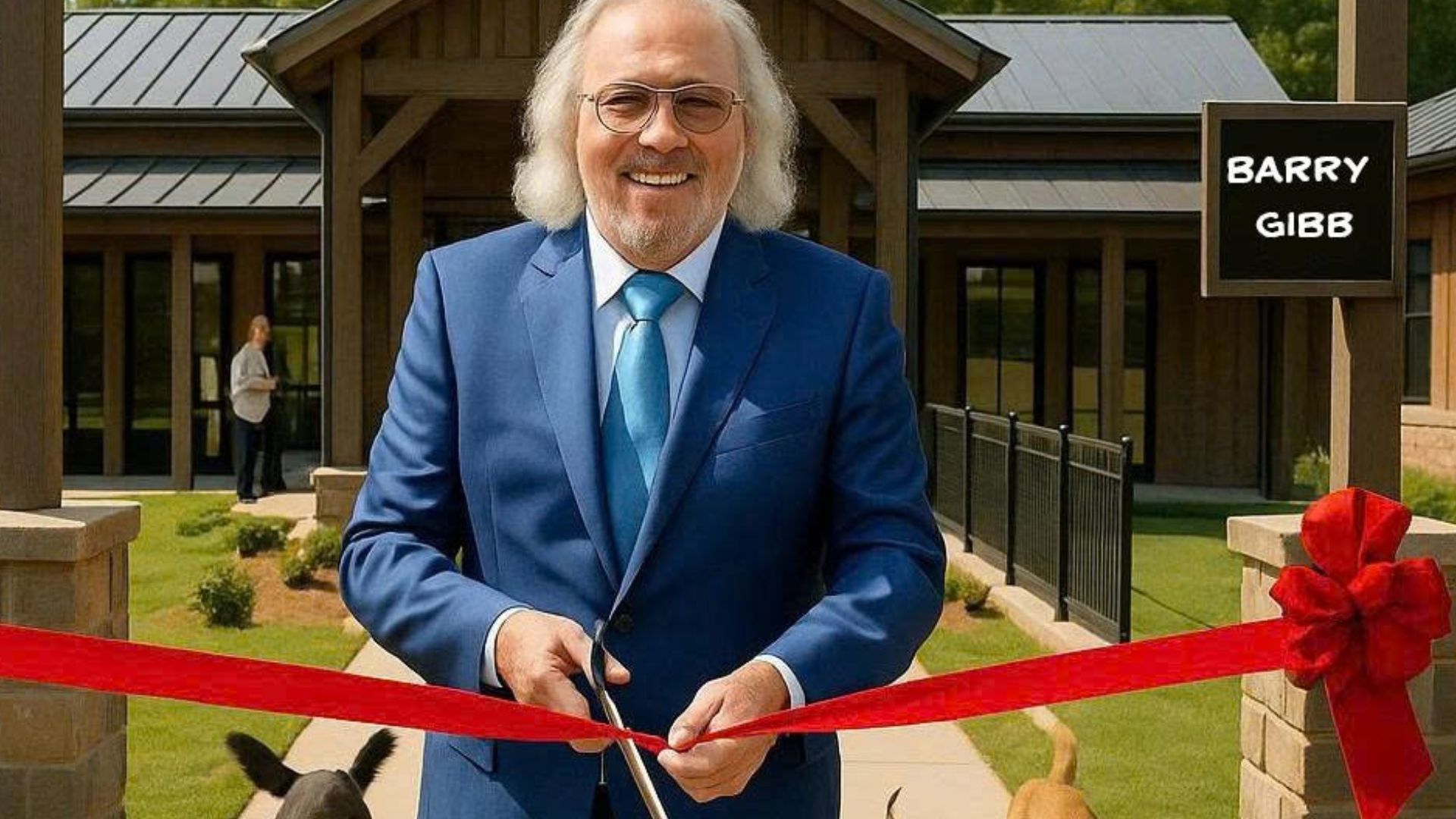
There are announcements that simply pass through the news cycle, and then there are moments that feel like they shift the tone of a life’s story. Barry Gibb’s decision to dedicate 1.5 million dollars to build a pet rescue sanctuary is one of those moments — not loud, not dramatic, but deeply, unmistakably human. It is not a new album, not a retrospective release, not a revival tour. And yet, in the landscape of his long and luminous career, it feels like one of the most intimate chapters he has ever written.
The story begins far from the bright lights of stages where he once soared with his brothers. It begins in quiet fields, with rescue animals pacing softly through grass, in a place where healing is not a performance but a slow, fragile return to trust. When Barry walked the grounds himself last week, kneeling to greet the dogs with the same gentle patience that once shaped his falsetto, the gesture resonated far beyond celebrity kindness. It felt like a continuation of the empathy that has threaded through his music for decades — the tenderness in his lyrics, the ache in his voice, the compassion that has always lived quietly under the harmony.
The sanctuary is not designed as a grand monument but as a refuge where peace comes in small, deliberate ways. There will be sunlit outdoor runs, rooms warmed for rehabilitation, soft spaces where frightened animals can learn to breathe freely again. And in a beautiful, almost poetic decision, the sanctuary will include a small music-therapy room. You can imagine the hum of an acoustic guitar, or a simple melody drifting through the air the way only Barry can make it drift — not to entertain, but to soothe. There is something striking about the idea of a voice that once carried stadiums now offering comfort to creatures who cannot applaud, cannot speak, but can feel.
That, in a way, has always been Barry Gibb’s gift. The Bee Gees wrote songs that captured heartbreak, yearning, devotion, and resilience, but beneath the falsetto shimmer there was always sincerity. A kind of emotional clarity. A quiet willingness to feel deeply. This sanctuary seems built from the same inner place — the part of Barry that has weathered loss, carried love, and found meaning in gentleness rather than spectacle.
And then there is the element no one can explain yet — a sealed, private section within the sanctuary that insiders say holds “something important.” Not a gimmick, not a press hook, but a deeply personal feature Barry has chosen not to reveal. Some speculate it may be a memorial space, perhaps a tribute to the brothers he loved and lost. Others imagine something symbolic, something meant to honor a lifetime shaped by loyalty, creativity, and unspoken grief. Whatever it is, the mystery doesn’t feel sensational. It feels sacred.
It is impossible not to see how naturally this project fits into Barry’s story. The man who once sang through heartbreak and raised his voice into the sky with his brothers has now chosen to give comfort to beings who cannot speak their fears. The artist who carried tender fragility in every verse is now building a place where fragility is protected rather than hidden. The quietest member of a legendary trio is stepping into a role defined not by spotlight, but by compassion.
What makes this moment linger is how unforced it feels. This sanctuary is not a brand extension or a philanthropic obligation. It is a gesture that mirrors the emotional core of his music: steady, warm, profoundly humane. A reminder that kindness is not a grand performance but a daily offering — a hand extended, a soft voice, a safe space created in a world that often feels too sharp, too fast, too indifferent.
In many ways, this project reframes what a legacy can be. Barry Gibb already changed the history of popular music. He already carved melodies into generations of memory. But a legacy is not only measured in records sold or stadiums filled. Sometimes it is measured in the quiet breath of a rescued animal finally sleeping without fear. Sometimes it is found in a room where music becomes comfort instead of applause.
Maybe that is why this story feels so moving. It tells us that gentleness has its own power. That even after decades of fame, someone can still choose tenderness over triumph. That even an icon can decide his most meaningful encore will echo not through concert halls, but through a sanctuary built on love.
And perhaps the most beautiful truth is this: Barry Gibb has spent a lifetime giving the world harmony. Now he is giving something even deeper — a place where healing can begin
the quietest acts of love can echo louder than any guitar ever could.