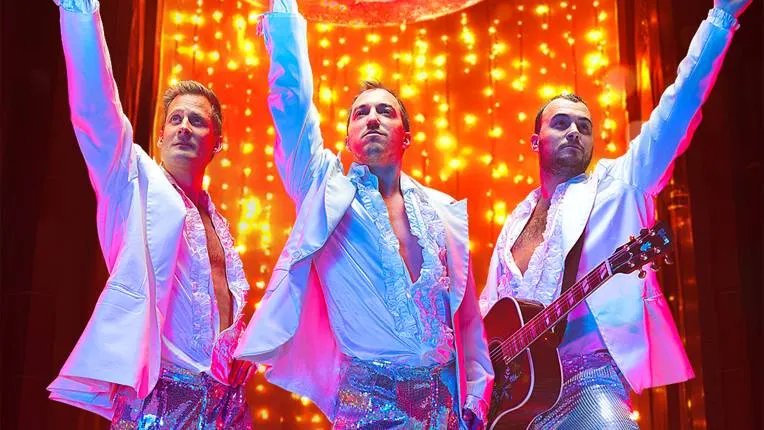
There are songs that feel like they were written by time itself — songs that capture both the pulse and the ache of being alive. The Bee Gees, with their shimmering harmonies and unmistakable falsetto glow, gave us two such timeless anthems: “Stayin’ Alive” and “How Deep Is Your Love.” They couldn’t be more different in sound or spirit, yet together they tell the full story of what it means to survive — and to love — in a world that constantly asks for both.
When “Stayin’ Alive” burst through the speakers in 1977, it wasn’t just a disco track. It was a heartbeat. Beneath its strut and swagger lay the quiet desperation of a man walking through chaos, trying to keep his rhythm in a world that doesn’t slow down. The bassline pulsed like a survival instinct; the beat never broke stride. “Life goin’ nowhere,” they sang, and yet the groove kept moving forward. That contradiction — dancing through despair — was the secret to its power. It made survival sound like defiance.
Barry, Robin, and Maurice Gibb turned resilience into music. You could hear the city’s noise in their rhythm, but also its hope. “Stayin’ Alive” was the sound of every person who refused to be erased by circumstance. It was strut and soul, motion and meaning. When John Travolta’s character walked the Brooklyn streets to its beat, he wasn’t just walking to a soundtrack — he was walking to an anthem of identity. The song didn’t tell him who to be; it told him to keep being.
And then came the quiet mirror — “How Deep Is Your Love.” Where “Stayin’ Alive” carried the fight, this one carried the tenderness that follows the struggle. Released the same year, it moved like moonlight over the disco’s chaos. Every note was deliberate, every lyric fragile, like something whispered in the dark between two people afraid to lose each other. The Bee Gees stripped away the glitter and found what always lay beneath: vulnerability.
“How Deep Is Your Love” asked a question no dance floor could answer. It wasn’t about how loudly we live, but how deeply we feel. Love, here, wasn’t grand or loud — it was something to be protected. “I really mean to learn,” Barry sang, and it felt less like a lyric and more like a confession. The Bee Gees were reminding us that even in an age of movement and light, love still happens quietly. It asks, it trembles, it waits.
What makes these two songs so extraordinary is how they exist in dialogue with each other. One celebrates endurance; the other, surrender. Together they trace the emotional landscape of the late 1970s — a time of flashing lights, changing identities, and people trying to hold on to something real. “Stayin’ Alive” was about the outer world — its speed, its demands, its noise. “How Deep Is Your Love” turned inward — the softness we keep hidden until the night falls. The Bee Gees stood between those worlds, and somehow gave both a voice.
To listen to them today is to remember how human their sound was. Behind every falsetto was a heart, behind every beat a bruise. They wrote songs that never stopped feeling because they never stopped meaning something. “Stayin’ Alive” still feels like the anthem of persistence — for anyone who’s ever had to lift themselves up and keep going. “How Deep Is Your Love” remains the quiet ache beneath that strength — the reminder that survival without tenderness isn’t really living at all.
Maybe that’s why the Bee Gees endure. They didn’t just soundtrack a decade; they soundtracked emotion itself. They understood that our lives move between dance and stillness, noise and whisper, staying alive and loving deeply. And in the echoes of their harmonies, we can still hear both.
Because to live is to keep moving.
But to love — that’s how we stay alive.