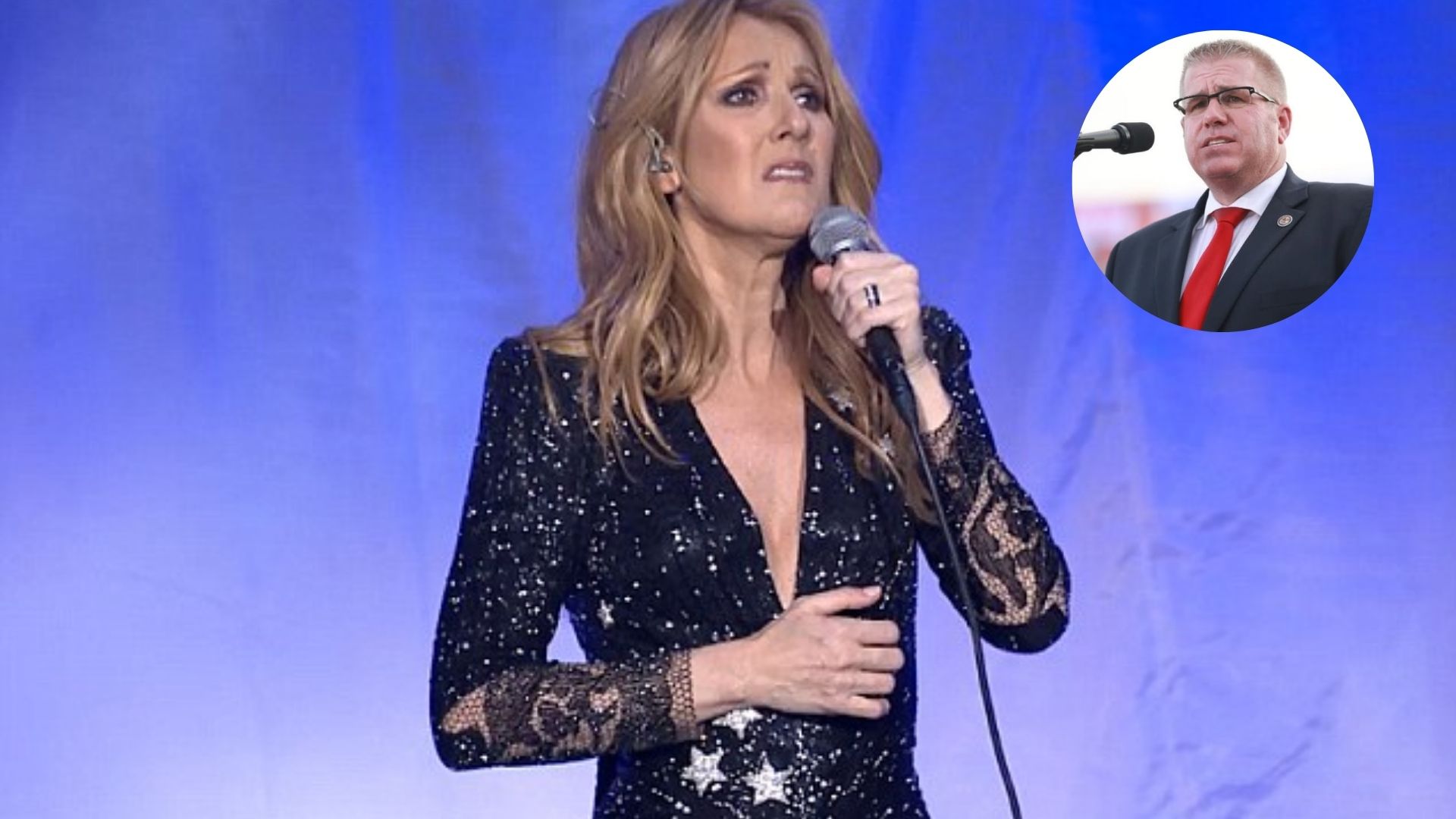
The world stood still for a few moments when news broke about the tragic helicopter crash that claimed the lives of Illinois gubernatorial candidate Darren Bailey’s son, daughter-in-law, and two grandchildren. The accident sent shockwaves across the nation — a story of unbearable loss that left even those far from politics in mourning. Amidst the sorrow, a voice rose — delicate, trembling, but filled with grace. Céline Dion, known across generations for her unmatched emotional depth, offered a musical tribute so heartfelt that many who witnessed it described it as “the sound of collective grief finding light again.”
The private memorial, held quietly in Illinois, wasn’t about grandeur or fame. It was about love — the kind that remains after loss, and the kind that music can sometimes capture when words fail. Dion appeared on stage in a simple black gown, no spotlight, no fanfare, only a single beam of soft light surrounding her as she began to sing “Fly.” The song, written decades ago after the passing of her young niece, carries lyrics that seem made for moments like this. The air in the hall grew heavy as her voice filled the space, fragile and steady at the same time. “Fly, fly little wing,” she sang, her voice catching on the word wing, and many in the audience wept quietly.
Those who attended the tribute said there was something different about this performance — something beyond professionalism or artistry. Céline Dion didn’t perform; she communed. The loss felt by the Bailey family seemed to flow through her, turning the pain into melody. Even people who had never been fans of her music said afterward that it was one of the most powerful expressions of empathy they had ever seen. One guest, wiping tears from her face, told a local reporter, “You could feel that she wasn’t singing to an audience — she was singing for them, for the family, for everyone who’s ever lost someone too soon.”
Céline’s history with grief is well known. Having lost her husband, René Angélil, and later her brother, she has often turned personal pain into art that comforts millions. Over the years, she’s said that music has been her greatest form of prayer. And that night, standing before a grieving community, her song became a prayer shared by everyone in the room. “I sing tonight for those whose wings came too soon,” she said softly before the final chorus, her voice nearly breaking. “May love guide them home, and may peace comfort those who stay behind.”
Outside the venue, hundreds of fans gathered with candles and flowers. Some played Céline’s older songs on small speakers — “Because You Loved Me,” “My Heart Will Go On” — songs that have long served as soundtracks for moments of love, loss, and remembrance. Others simply stood in silence, heads bowed. When clips of her performance surfaced online hours later, social media erupted with emotion. The video quickly went viral, not because it was polished or glamorous, but because it was raw. You could see her eyes glisten with tears, her voice falter for a moment, her hand trembling as she pressed it to her heart. The performance reminded everyone of something timeless — that even the most powerful voices in the world can tremble with grief, and that sometimes, that trembling is what makes them truly beautiful.
In the days that followed, messages poured in from across the world. Fans thanked Dion for using her voice to bring comfort where words failed. Many mentioned how her gesture reminded them of the importance of compassion in times of division. One post read, “In a world filled with noise, Céline chose silence and song — and somehow, that spoke louder than anything else.”
The Bailey family released a statement expressing gratitude to everyone who had reached out and to those who shared in their pain. They said that while nothing could replace what was lost, they found solace in knowing their loved ones’ lives had inspired such unity and kindness. For them, Céline’s performance was not just a tribute; it was a reminder that love — in its purest, most enduring form — never truly leaves.
For Céline Dion, this was not a return to performing in the traditional sense. It was something far more personal. Friends close to her have said that while her health challenges have limited her public appearances, she remains deeply connected to the emotional power of music. This night was proof that her voice, though quieter, still holds the ability to move mountains.
The performance also served as a reflection on the resilience of art and humanity. In tragedy, there is often silence — the kind of silence that feels endless. But Céline’s song broke through that silence, not with noise, but with tenderness. It reminded everyone that grief can coexist with beauty, and that remembrance can take the shape of music that heals.
As the final notes of “Fly” faded, there was no applause — only quiet sobs, joined by the soft rustling of people holding hands. In that shared stillness, it became clear that the night wasn’t about mourning alone. It was about remembering that love — the same love that Céline Dion has sung about her entire career — is what keeps us human. And even in the darkest of nights, that love still finds a way to sing.