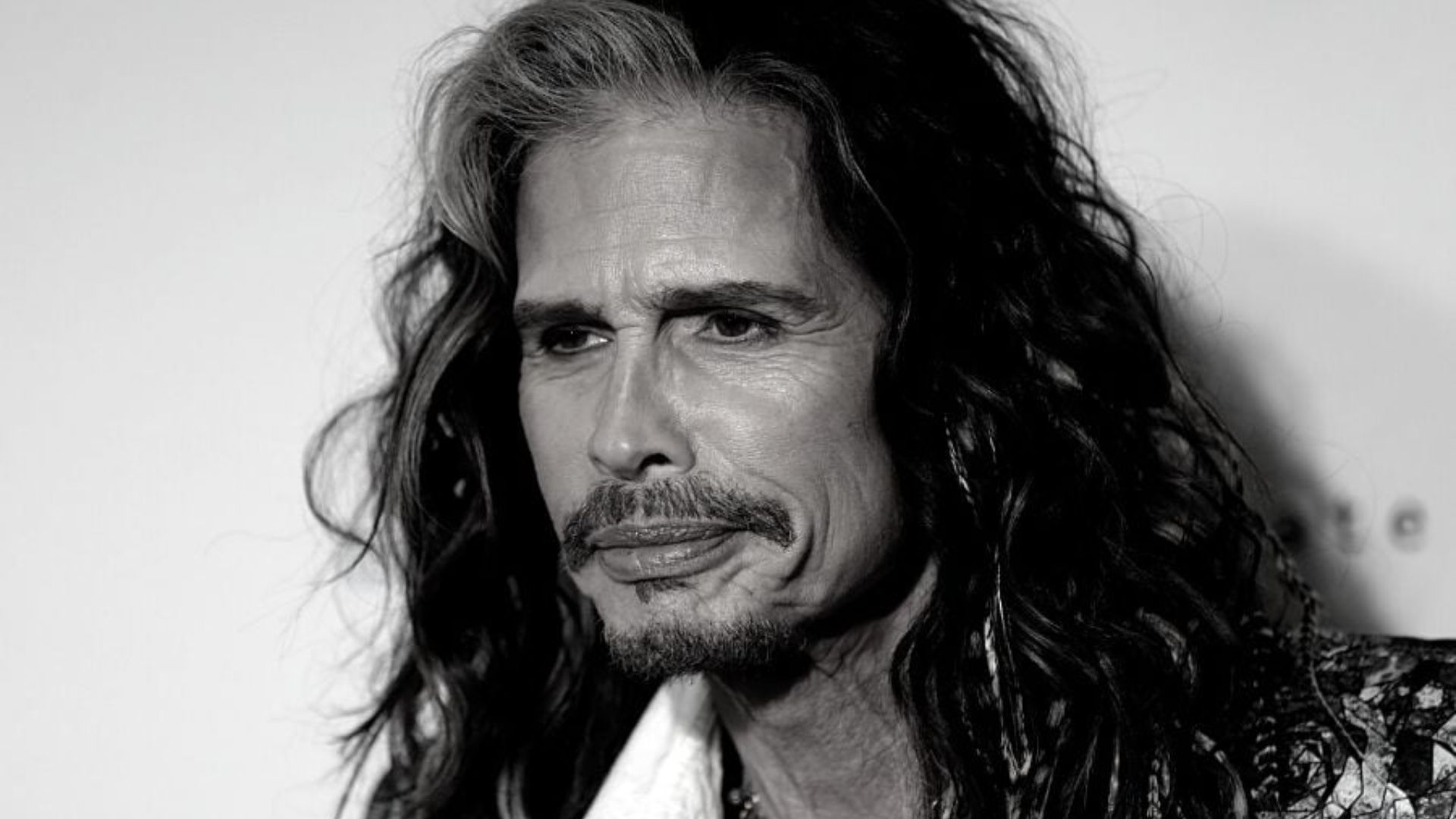
There are nights in music that live far beyond the encore, moments that transcend lights, sound, and fame — and instead become part of our shared human story. Last night in Nashville, Steven Tyler reminded the world why he’s not just a rock icon but a symbol of what music can still mean in a divided age.
It happened halfway through what was already an electrifying show. The stage glowed red and gold, the crowd roared, and the air pulsed with the rhythm of decades of rock history. Then, as the band prepared to launch into another hit, a ripple of tension stirred near the front of the stage — a handful of anti-American chants, faint at first, then louder. You could feel the energy shift. Some fans looked confused, others angry. Security began to move. The music stopped.
And then Steven Tyler — 76 years old, wild-haired, eyes blazing with that unmistakable fire — stepped forward. He didn’t scold, didn’t shout, didn’t storm off. Instead, he did something only a true artist could do: he turned conflict into connection. He took the mic in both hands, smiled that sly, knowing grin, and began to sing “God Bless America.”
No instruments. No lights. Just his voice — gritty, soulful, trembling with both fragility and power. For a moment, you could hear a pin drop. The crowd froze, unsure what to do. But then, like a wave breaking free, voices began to rise. One by one, people joined in, singing with him. Within seconds, 25,000 voices filled the stadium, blending into a single, thunderous chorus that rose into the warm Tennessee night.
Flags waved. Hands lifted. Strangers who moments ago stood on opposite sides of an argument now sang together. It wasn’t rehearsed or planned — it was raw, spontaneous unity, born out of the purest form of emotion that music can summon. In those few minutes, Steven Tyler reminded everyone why songs matter. They don’t just entertain; they heal, they bridge, they bring us back to the heart of who we are.
When the final words of the anthem echoed into silence, Tyler didn’t make a speech or ask for applause. He just nodded, his eyes glistening, and said softly, “That’s what love sounds like.” Then, with that same energy that made him a legend, he turned to his band and roared into the next song — a seamless return to rock, but somehow deeper, richer, more human.
Those who were there said it didn’t feel like a concert anymore. It felt like a moment of grace. In a world where outrage comes easy and silence often feels safer, Steven Tyler chose courage. He showed that music can still rise above the noise — that it can silence anger without shaming, that it can unite without demanding agreement.
For decades, Tyler has embodied chaos and charisma. He’s been the voice of rebellion, the showman who danced on the edge of madness and melody. But last night, in that quiet moment under the Nashville sky, he showed a different kind of strength — not the kind that breaks amplifiers, but the kind that breaks through division.
It’s strange how time reshapes our heroes. The same man who once screamed defiance into microphones now whispers unity with the same conviction. Yet, that’s the essence of Steven Tyler — a man who never stopped evolving, never stopped believing that music could still move the soul of a crowd.
As fans left the arena, many were crying. Not because of sadness, but because they had witnessed something real. Something that, for a few fleeting minutes, felt like hope.
And maybe that’s what Steven Tyler has always done best — not just perform, but transform. He’s proof that the spirit of rock and roll isn’t about noise or chaos. It’s about heart, resilience, and the courage to keep singing, even when the world seems off-key.
In Nashville, under the stars, a man once called the “Demon of Screamin’” became something gentler, truer — a reminder that even after all the years, all the madness, and all the fame, Steven Tyler still knows what matters most.
Not the spotlight. Not the stage. But the song that brings people together.
And last night, he sang it perfectly.